
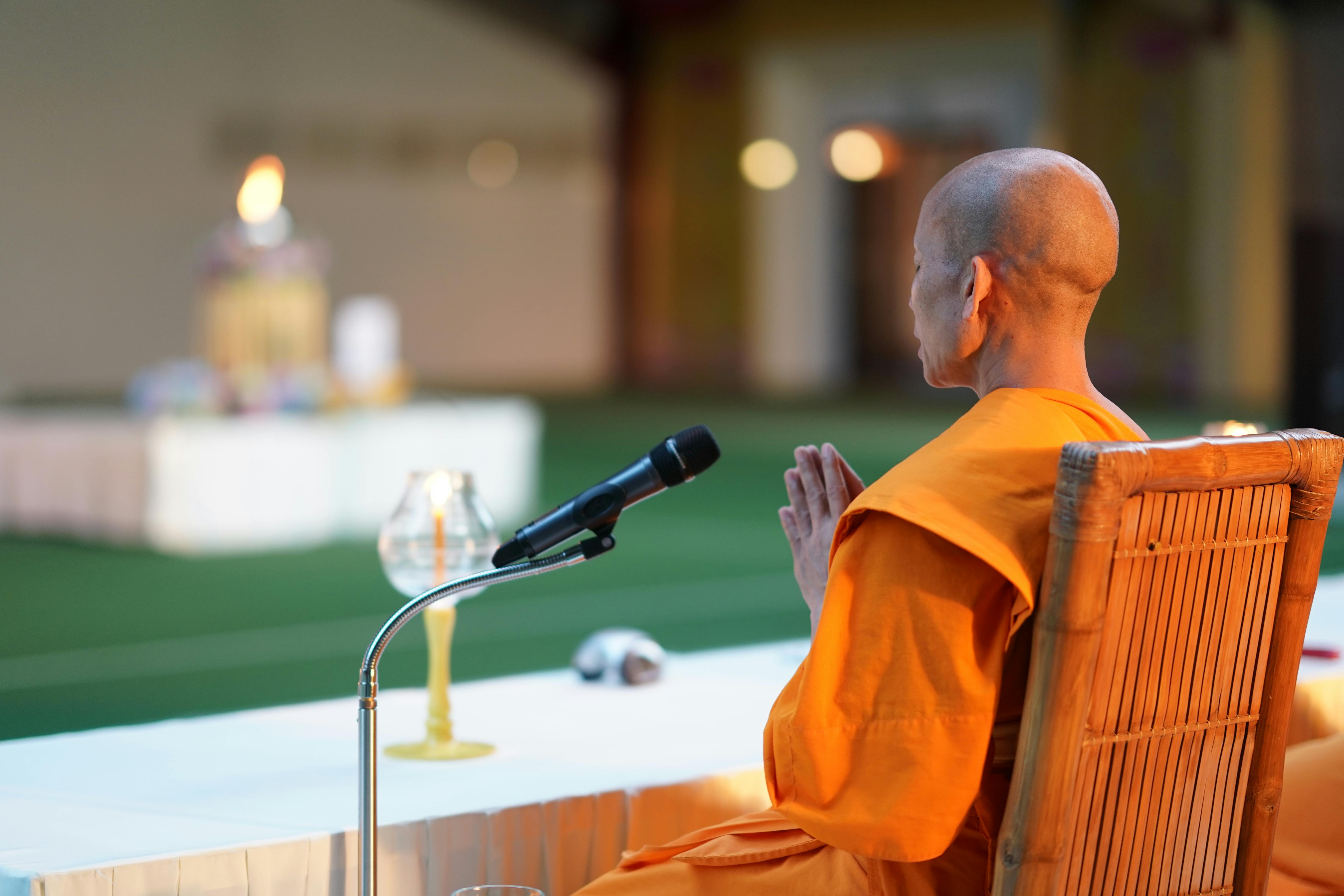
Music is nearly universal in religious practice, across traditions that share almost nothing doctrinally. Several of the reasons are physical, and they operate whether or not a participant believes anything.
Singing imposes a breathing pattern
Sung phrases require a long, controlled exhalation and a short intake, which is close to the pattern deliberately taught in breathing practices.
Extended exhalation is associated with a shift toward the calming branch of the autonomic nervous system, producing effects singers notice without instruction.
A congregation singing together is therefore doing something physiologically specific, arrived at long before the mechanism was described. Slow hymns and long chant lines extend the exhalation further than ordinary speech does.
Synchrony affects how a group feels
Acting in time with others — singing, chanting, moving together — is consistently associated with increased feelings of closeness and cooperation among participants.
The effect appears in settings with no religious content at all, which suggests it belongs to the coordination rather than to the beliefs involved.
Traditions that emphasize collective sound are recruiting an effect that reliably strengthens the group performing it. Unison is doing work that a soloist performing to a seated audience cannot do.
Buildings were built for the sound
Stone interiors with hard surfaces produce long reverberation, so individual voices blur into a single sustained mass of sound.
That blurring makes it difficult to locate any one voice, including your own, which changes the experience of participating and lowers self-consciousness.
Chant traditions developed in such spaces, and their slow lines and sustained tones suit acoustics where fast passages would smear into noise.
Memory attaches to melody
Text set to music is retained far more reliably than spoken text, which mattered enormously in periods when transmission was largely oral.
Metrical and melodic structure constrains what words can be substituted, so a sung text drifts less across generations than a recited one.
This is part of why liturgical music is conservative: the form is doing preservation work as well as aesthetic work.
What the explanation does not settle
Describing mechanisms does not determine what participants are experiencing or whether their interpretation of it is correct.
Traditions describe these moments in their own terms, and a physiological account sits alongside those descriptions rather than replacing them.
The observation that reliably holds is narrower: the practices are effective at producing a shared state, and that effectiveness is one reason they persisted.